

F1 Streetwear in India - Why Motorsport Fashion Is Exploding Right Now
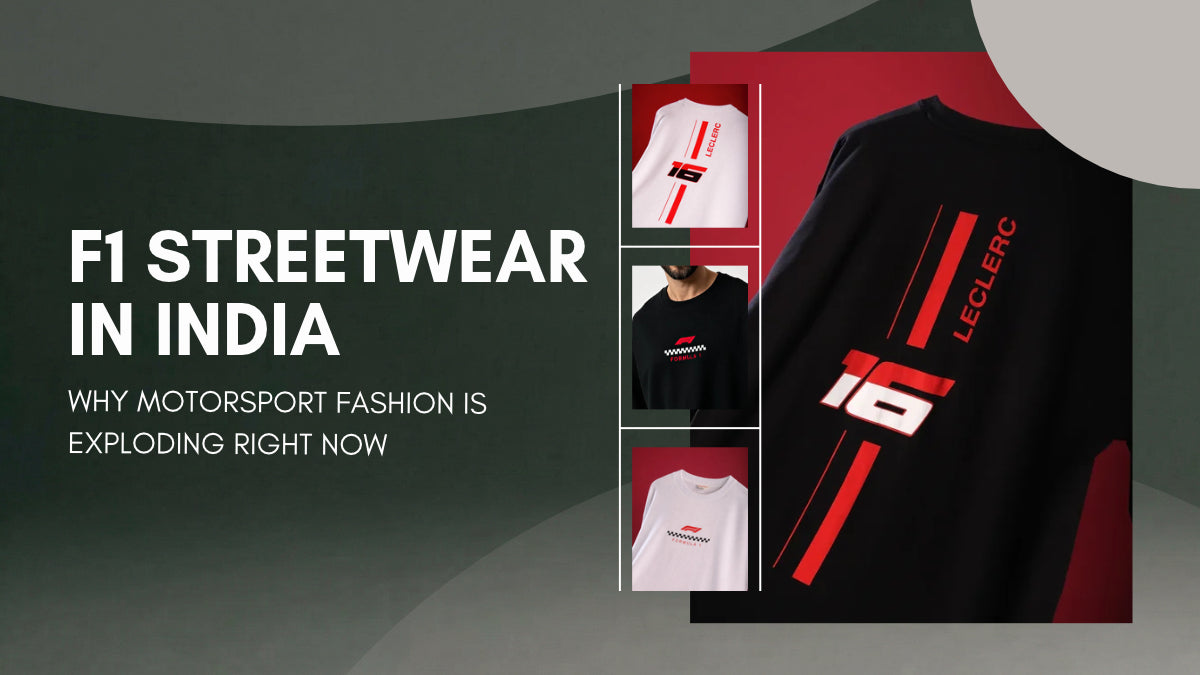
Three years ago, if you wore an F1 t-shirt in India, someone would ask you if you were into cars.
Today, they ask you which team.
That is not a small shift. That is a cultural gear change that happened faster than almost anyone in Indian fashion predicted. Formula 1 went from a sport that serious motorsport fans followed on pirated streams to something that young urban India actively tracks, discusses, and yes, wears.
How did that happen? And more importantly, what does it mean for how you think about F1 streetwear in India right now?
How Formula 1 Went from Niche Sport to Cultural Moment in India
The turning point was not one race or one driver. It was a documentary series on a streaming platform that turned the paddock into a cast of characters people actually cared about.
Suddenly F1 was not just about lap times. It was about personalities, rivalries, team politics, and personal stories. Indian viewers who had never watched a qualifying session started following Verstappen's dominance, Hamilton's legacy, and Ferrari's heartbreaks the same way they follow a cricket series.
The audience that came in through that door was young, social media-fluent, and used to expressing identity through what they wear. It was only a matter of time before that fandom showed up in wardrobes.
Add to that India's growing streetwear culture, oversized fits, bold graphics, quality-conscious buyers who are done with fast fashion, and you have a perfect setup for F1 streetwear to land hard.
Why F1 Graphics Work So Well in Streetwear
Not every sports aesthetic translates cleanly to everyday clothing. Cricket whites do not make for compelling graphic tees. Football jerseys are too structured and context-specific.
F1 is different. The visual language of motorsport- speed lines, driver numbers, circuit maps, livery colour blocks, precision typography- is inherently graphic and design-forward. It was built to be seen at 300 kmph and still be instantly recognisable.
That same visual clarity reads beautifully on a tee. A circuit line graphic on a black base. A driver number with clean negative space around it. A team colour accent that does not need a caption to communicate.
F1 designs also have an edge that most sportswear graphics lack: a sense of technical precision. They do not feel decorative. They feel engineered. And that quality, interestingly, is exactly what makes them appeal to people who are not even hardcore motorsport fans.
How Indian Streetwear Buyers Are Wearing F1 T-Shirts
The campus crowd is leading it. College students in metros- Mumbai, Bengaluru, Delhi, Hyderabad- are wearing F1 tees the way they wear any statement graphic. The graphic means something, the fit is comfortable, and it signals cultural awareness without trying too hard.
The watch party circuit is growing too. Every race weekend now has a social layer in Indian cities - bars, friend groups, apartment gatherings built around a Grand Prix broadcast. F1 streetwear has become the unofficial dress code for these events.
Beyond that, the everyday rotation is where it gets interesting. Buyers are not putting F1 tees away between race weekends. They are wearing them to college, to malls, to casual dinners. Because a well-designed F1 graphic tee - one built for streetwear, not just fandom - works in all of those settings.
What Separates F1 Streetwear from Regular Fan Merch
This distinction matters more than most buyers realize before they make a purchase.
Official F1 merchandise is designed for the circuit. It is logo-heavy, sponsor-forward, and built for event contexts. It works in the stands. It looks odd at a Saturday brunch.
F1 streetwear takes motorsport references and reinterprets them through a design-first lens. The graphic is bold but balanced. The silhouette is built for everyday wear. The fabric is chosen for comfort and durability, not just event volume production.
The Litt's F1 t-shirt collection sits firmly in the streetwear lane. Every piece is built on 240 GSM BCI cotton with drop-shoulder oversized fits - the same construction standard as the rest of the range. The graphics are designed to work on a Tuesday morning, not just a race Sunday.
That is the line. Merch gets worn once. Streetwear gets rotated.
Where F1 Streetwear in India Is Headed in 2026
Driver-specific designs are becoming the dominant format. General team branding is giving way to more personal, driver-led references. Verstappen's number 1, Piastri's 81, Leclerc's Ferrari identity - these are the design anchors that Indian F1 fans are gravitating toward.
Colour preferences are also evolving. Black bases with accent graphics - red, papaya orange, navy - are leading the market. White base tees are growing as a secondary option for buyers who want the same energy with a cleaner, daytime-friendly finish.
Indian D2C brands are filling the quality gap that was left by expensive international merch and cheap knockoffs. The Litt's F1 collection is specifically positioned to be that middle ground - genuine quality, Indian pricing, designs built for how Indian buyers actually dress.
For a deeper look at how F1 graphics became streetwear, read How F1 Graphics Became Streetwear.

